
Drippings from the Honeycomb
More to be desired are [the rules of the Lord] than gold, even much fine gold; sweeter also than honey and drippings of the honeycomb. (Psalm 19:10)
|
Traditionally Roman Catholicism, Eastern Orthodoxy and Protestantism have been recognized as the main visible branches of Christianity. However, since the rise of Pentecostalism, with all of its distinctives, it is worth asking if Pentecostalism is part of Protestantism or unique enough to be its own branch of the visible family tree? A Brief History Coming onto the scene through an indebtedness to dry and dead nominal liberal Protestantism, the holiness tradition and Baptist leaders, Pentecostalism had its origin at a ‘Bible study’ in Topeka Kansas in 1901 on gifts of the Spirit. More famously it gained attention through a ‘revival’ in Azuza Street, California in 1906. Not without an early moral rocky road Pentecostalism soon burst onto the world stage, largely indebted to the subjectivity and experientialism of Romanticism and Post-Modernism. It progressed through 3 phases: Pentecostalism (think denomination), the Charismatic Movement (think Pentecostal doctrines entering traditional denominations) and the New Apostolic Reformation (a belief God is reforming His Church through a return to a revival like in Acts with apostolic figures). Though not universal it has deeply imbibed the Word of Faith movement and Health and Wealth message. Today Pentecostalism is a broad movement with some 600 million adherents (though about ¼ of all Pentecostals are not Trinitarian). Three Caveats:
A Chart of Contrasts: 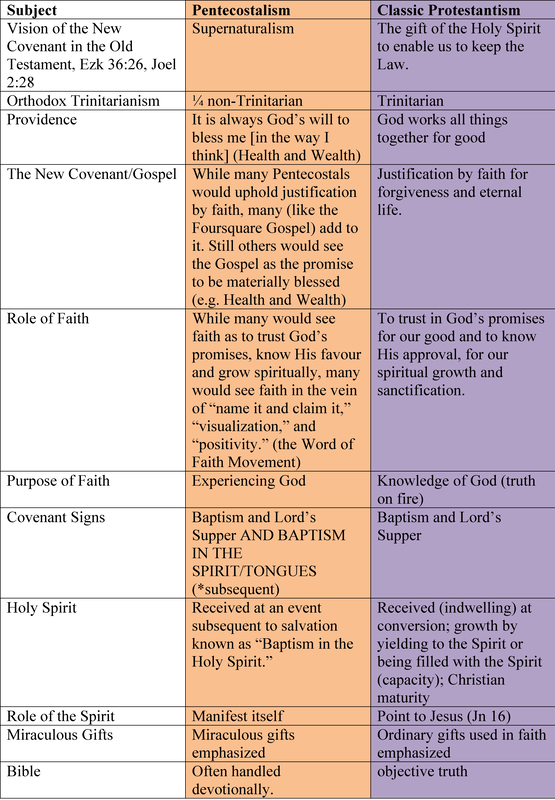 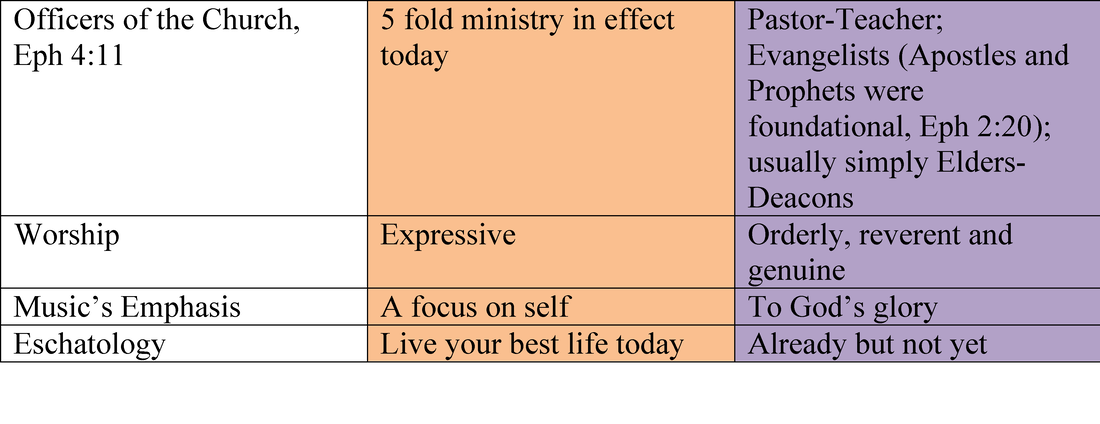 From a cursory survey of key areas of faith and practice, much like the differences between Roman Catholicism and Orthodoxy, it is apparent that Pentecostalism, while related to Protestantism historically and in many ways similar, is in fact a fourth branch of visible Christianity. This is especially so where the “Health and Wealth” and “Word of Faith” movements are felt strongest and may be less apparent in more settled Pentecostal denominations or where the charismatic stage is less strongly exerted upon a individual/church/denomination.
|
LocationPO Box 73,
144 Lorne Street, Markdale N0C 1H0 |
Join by zoom |
Contact us |
Donate |
|
