Markdale Baptist Church
  • Home
  • Sermons
  • Beliefs
  • Ministries
  • Calendar
  • About

Drippings from the Honeycomb

 More to be desired are [the rules of the Lord] than gold, even much fine gold; sweeter also than honey and drippings of the honeycomb. (Psalm 19:10)

Unpacking Christmas

12/20/2023

 
Christmas—the real Christmas—lies buried beneath so many layers of wrapping, adornments and tradition that it is worthwhile pausing to unwrap it and find true joy.
 
DEFINING CHRISTMAS | NOUN [krísməs]
The season/day of the year when the birth of the Christ child is celebrated; God’s anointed One, the promised deliverer. In Jesus God took on human form becoming this Christ.
 
Christmas is two words: Christ and missa; Latin from the worship service’s closing prayer meaning “go” or “send” (i.e. mission).  Having celebrated the birth of Christ the early Christians went out to proclaim the glad tidings of His coming.  The first instance was in AD 336.
 
Christmas is an ancient tradition, however it endures as it is real and relevant; God’s rescue plan that enables a relationship for all who repent and believe.
 
IT’S REAL | MATTHEW 1–2 & LUKE 1–2
Confirmed by ancient Greek, Roman and Jewish sources and faithfully recorded
in the Gospel accounts, Jesus was actually born. A first ‘Christmas’ really happened.
 
Josephus (d. 100) said, “Now there was about this time Jesus, a wise man.”
 
The biblical author Luke gives more detail by saying, “In those days a decree went out from Caesar Augustus.” You can read the whole story in Matthew 1–2 and Luke 1–2.
 
IT’S RELEVANT | JOHN 14:9 & ACTS 17:27
Christmas is not just a quaint old story; nor is God a far off and distant reality. We don’t have to wonder who God is or what He is like or how to come to know Him. Jesus said “whoever has seen Me has seen the Father” and “I am the way, and the truth, and the life. No one comes to the Father except through me.” This is because Jesus is the promised Christ, the son of God.
 
IT’S ABOUT RESCUE | MATTHEW 1:21
Jesus’ name means ‘salvation.’ This is why the angel instructed Joseph to “call Him Jesus, for He will save His people from their sins.” (Mt 1:21).
 
While Jesus was a wise teacher, ultimately, he was born the Christ not just to teach but to rescue sinners through His life, death and resurrection.
 
Before Christmas can be seen as good news we must first acknowledge the bad news.
 
IT ENABLES A RELATIONSHIP | LUKE 24:46–47
As sinners, we do not know God―in fact, we are enemies of God. Yet in His grace God made a way to have a relationship with Him. The appointed means was faith—trust—in the good news of His Son: that God sent His Son, Jesus, who lived and died and rose again so that those turn and trust in Him might receive forgiveness and life eternal through the gift of the Holy Spirit. Through belief in this Saviour we are reconciled with God, adopted and called to live as His children.
 
When we unpack Christmas we find that true joy and meaning comes not in the trappings but in the offer and ultimately acceptance of Christ. As the carol says, “Let every heart prepare Him room.” May your joy be made complete this Christmas by receiving God’s grace through faith in His Son, the Christ.
A Basic History of Christmas

12/15/2023

 
Picture
Christmas has always been celebrated like we presently experience it, correct? History shows a varied tradition from no celebration to celebration.

APOSTLIC (AD 33–100)
Matthew and Luke dedicate two chapters to the infancy stories of Jesus in their Gospels to show how Christ fulfilled OT prophecies. John stressed the significance of the Incarnation, “the Word became flesh.”

However, during the first century the Church did not celebrate Christmas. Emphasis was placed on the Lord’s Day as a weekly remembrance of the Resurrection, which was commemorated annually at Passover.

PATRISTIC (AD 100–500)
The Apostolic trend continued. Many early Christians even opposed remembering the birthdays of martyrs or Jesus seeing their death as their birthday.
 
The first record suggesting the date of Christ’s birth as December 25 was in AD 221 by the Christian historian Sextus Julius Africanus. (Previously it had been remembered in conjunction with His baptism on Jan 6. Some eastern churches continued to observe this but eventually Dec 25 became the majority view). Several explanations have been offered:
  • The date was chosen to replace the pagan Roman celebration of dies solis invicti nati (“day of the birth of the unconquered sun,” [c.f. Mithraism]). This was a pagan winter solstice festival, joy in the midst of winter’s darkness. Saturnalia, Dec 17–21 was likewise a time of lights, parties and gift giving.
  • Another saw Creation as being March 21 and Jesus’ conception—the light of the world—on the fourth day of creation. With a March 25 conception date Jesus was born on Dec 25. (Sextus)
  • Still another similar view was the belief that prophets were conceived on the same day as their death. If Christ died on March 25, adding 9 months to His birth brings you to Dec 25. (Pseudo-Crysostom?).
While the later theories are plausible that Dec 25 ‘baptized’ pagan traditions to weaken them is the most likely. Missiologically this was clever but not without danger.
 
That Christmas replaced pagan festivals is further evidenced in when the first Christmas is recorded. It was in Rome in AD 336, after Constantine had made Christianity legal and even the favoured religion of the Empire. As a result the 4th century saw a “powerful trend towards a greater use of ritual and ceremony.” (NN1.97). From Rome this new ceremony spread, attested by numerous 4th century sources.
 
Christmas is two words: Christ and missa; Latin from the worship service’s closing prayer meaning “go” or “send” (i.e. mission).  Having celebrated the birth of Christ Christians went out to proclaim the glad tidings of His coming. 
 
Still Christmas was a smaller festival compared to the Passover/Easter and the growing traditions of Holy Week and Lent until the 9th century when it attained its own liturgy. Christological debates also helped to cement the importance of Christmas (e.g. Chalcedon, 451)
 
MEDAIEVAL (AD 500–1500)
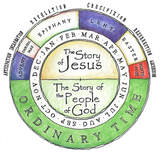
Festivals surrounding the remembrance of Christ’s birth proliferated during the Middle Ages. The basic pattern was present by AD 600: Advent (24 days before Christmas, c. 500s), Christmastide (12 days of Christmas beginning Dec 25–Jan 5), which ended with Epiphany, Jan 6 (wise men). Christmas became part of the elaborate series of festivals to saints and other holy days. The development of a Church year or calendar was ‘complete.’ Gifts were first given in the 1400s.

REFORMATIONS (1500–1600)
At the Reformation Lutherans and Anglicans modified and simplified the celebration of Christmas but retained it (e.g. Martin Luther wrote ‘Away in a Manger’). The Reformed, Puritans and Presbyterians did not celebrate Christmas. They saw it as a Catholic tradition with no warrant in the Bible. They followed the regulative principle.

POST-REFORMATION (1600–1700)
Parallel traditions, some celebrating Christmas and others not continued amongst Protestants. Puritans in England and New England banned Christmas altogether. Baptists were part of this tradition who until the late 1800s did not celebrate Christmas. Still, within the Dissenting tradition new carols were written like Isaac Watts’ ‘Joy to the World’ (Congregationalist) and ‘Hark the Herald Angels Sing by Charles Wesley (Methodist). From hymnbooks some Dissenters sang at least some carols around Dec 25. Gift giving also increased during this period.

MODERN (1800s–1900s)
For many Protestants, the presence of high-church traditions coupled with Romanticism (feeling and expression), biblical liberalism and the softening of denominational traditions due to deconfessionalism all contributed to a rise of the celebration of Christmas in traditions which hadn’t previous placed great or any emphasis upon them.

The Victorian age was one of expression. Carols proliferated. Cards were given (first commercial, 1843). Industrialization made affordable gifts available, beginning the commercialization of Christmas.

The Christmas tree, which had been a German tradition dating to the 1500s, was brought into England from the Germany by the Prince Consort (1848) and made popular by Queen Victoria. Given Germany was one of the later European nations to be evangelized there is an evident link to medieval paganism, and even tree worship in ancient paganism. Slowly trees made there way into church sanctuaries.

Perhaps the largest change to Christmas during this time relates to the mythical figure of Santa Claus. Rooted in Saint Nicolas with pagan embellishments, through commercialization, the man in the big red suit co-existed beside Christ, often even in Christian circles.

Many of these trends continued into the 1900s; culture and Christianity co-existing and often being tightly interwoven, Christmas culminating on the 25 rather than the 6th of January.  

POST-MODERN (late 1900s–2000s)
By the late 1900s it became clear Christ had been forced out of Christmas. Some advanced ‘political correctness’ such as “happy holidays.” Christmas was now about Santa and gifts and family. ‘Keep Christ in Christmas,’ was the slogan of conservative advocates.  

REFLECTION
Christmas is not inherent to Christianity but was developed, along with associated symbolism, over 1700 years.  

One of the blessings of the Post-Christian scene is that it is ripe for reflecting upon Christian beliefs and practices (ecclesia semper reformanda est, the Church is always to be reforming):
  1. The Lord’s Day along the Lord Supper are what we are commanded to remember, however, given the weight in the narrative to establish the New Covenant of Jesus life, death, resurrection and sending forth of the Spirit, I think it appropriate to modestly commemorate: the birth of Christ (Incarnation/Christmas), His Death and Resurrection (Passover/Good Friday and “Easter”) and the sending of His Spirit (Pentecost).
    1. Faced with secular Christmas other Protestants feel a pull in the opposite direction, to find meaning in post-Christianity by embracing elements of the Church year.  
  2. Given how few non-Christians attend any Christmas services I think worship at Christmas will shift toward an occasion for believers to worship, remember and be instructed (vs. outreach or a community event). This in turn will deepen and refine our traditions. Ultimately, this will produce lives and worship gatherings that will be of greater interest to the earnest inquirers of our culture and those we’re witnessing to.
Some of our Christmas traditions will change, vary from church to church or disappear altogether. However, the fact that Christ was born will remain a cardinal Christian belief.
​
Bibliography
Oxford Dictionary of Christian History
Encyclopaedia Britannica
Nick Needham, 2000 Years of Christ’s Power

Saving Faith

12/7/2023

 
 True saving, or justifying, faith is the main grounds of Christianity.

Galatians 2:16 says that “we know that a person is not justified by works of the law but through faith in Christ.” It is through faith that we are saved from damnation. It is by faith that we are declared just or right before God. It is in faith that all the blessings of Christ are given to the unworthy. Yet what is this faith?

There are 4+1 necessary elements of saving faith: hear, agree, turn and trust.
  1. HEAR: Hearing the Gospel (Latin. noticia- to note it or hear it). Like responding to any message, we must hear the Gospel message in order to be saved.
    1. “Faith comes by hearing and hearing by the Word of God.” (Ro 10:17)
  2. AGREEING: We must not only hear it but believe it, agree or assent with our minds that it is true (assensus- to assent). We never act on messages we believe to be false.
    1. E.g. “Thus it is written that Christ should suffer and on the third day rise from the dead.” (Lk 24:46)
 * Here we must pause and observe an important point. This is where many professing Christians stop and confuse belief/agreement/assent with true saving faith. We do not self-realize or feel an interest in the Gospel to be saved. This is where the demons stop! “Even the demons believe in God and shudder,” James 2:19 tells us.
 
   3.     TURN: The Gospel calls us to respond. This response involves turning (repenting) from our             sin, changing our mind, changing direction. We turn from sin and toward Christ.                                 (poenitentiam- to show penance, or sorrow; to change direction; to change one’s mind.                       From the Greek μετάνοια).
                    a.      “Repent and believe in the Gospel.” (Mk 1:15)
  1. 4. TRUST. Trust, or faith, is a relational word. Faith is not a noun but a verb. It is to trust in what Jesus has done (life, death and resurrection) and trust in His promise to rescue and give life. It is to actively cry out to Christ for mercy; to rely upon Jesus to save us. (fiducia-confidence, trusting).
    1. See Mk 1:15 above.
 
All of this can of course appear as if it happens in a moment. For example someone could hear the Gospel, assent to it, recognize without convincing their life is on the wrong path turn and trust in an instant. Or one could hear the Gospel many times, wrestle with believing it to be true, wrestle with their sin and finally come to a place where they actually trust in Jesus. Conversion is like an accordion, either all bunched up or discernible over time. Regardless these are the steps the Bible lays out for us to discern saving faith. 

So we must hear, agree, turn and trust in order to be saved and we know someone is saved because they persevere in trusting Christ’s promises and commands. See Paul and James. 


  1. 5 WALK: James tells us we prove our faith through our perseverance, through an active and ongoing faith that works, or is obedient. If someone has trusted in Jesus they receive the Spirit who ensures they go on being saved. If someone says they are a Christian but their life doesn’t consistently match their profession there can be little assurance, indeed the very real possibility that on Judgement day they will hear the words, “Depart from me.” (Mt 7:23 ) (opera- our works, literally ‘acting out our faith’ in a real sense).
    1. Speaking of false teachers Jesus gave us a valuable principle, “you shall know them by their fruit.” (Mt 7:20).
*The first step in following Jesus is to be baptized; how we make our private faith public.
This is the test of faith we ought to look for in ourselves and in those who profess to be Christians. 

Sovereign, Electing Grace

12/7/2023

 
In our national statement of faith we affirm that “salvation is by the sovereign, electing grace of God.”[1] What is this?

It has a linguistic, biblical, theological and historical meaning.

Firstly, when handling the doctrine of election it must be remembered that it, like the Trinity and Creation, election is a “high mystery” of the Faith to be handled with “special prudence and care” (1689. 3.7).

Linguistic
Sovereign: Sovereign means to have complete claim and control (e.g. arctic sovereignty). The Lord is sovereign. He is a King who reigns. His sovereignty extends even to salvation. “Salvation belongs to the Lord.”
Electing: To elect means to choose (e.g. electing a new government). To sovereignly elect/choose in salvation means that salvation is rooted in God’s choice.
Grace: Is God’s unmerited favour toward sinners. Since we are totally depraved, dead (Eph 2) and not seekers of God (Ro 3), we could only be saved if God chose to sovereignly save us in accordance with His grace.

Biblical
Students of the Bible should be familiar with these words and concepts. Without accepting this doctrine there will be many things in the Bible that will remain closed and confusing to us. Election is a plain and unmistakable teaching of the Bible. There are numerous passages that speak of God’s free choice in salvation.
  1. Deut 7:6–7: “For you are a people holy to the Lord your God. The Lord your God has chosen you to be a people for his treasured possession, out of all the peoples who are on the face of the earth. 7 It was not because you were more in number than any other people that the Lord set his love on you and chose you, for you were the fewest of all peoples.”
  2. Ephesians 1:4–5: “even as he chose us in him before the foundation of the world, that we should be holy and blameless before him. In love he predestined us[a] for adoption as sons through Jesus Christ, according to the purpose of his will,
  3. 2 Timothy 1:9: “who saved us and called us to a holy calling, not because of our works but because of his own purpose and grace, which he gave us in Christ Jesus before the ages began”
  4. Rev 13:8 and 17:8: “names have not been written in the book of life before the foundation of the world.”
It is difficult to kick against the goads, or the plain meaning of Scripture.

Theological
In theological terms, what does this mean? How might we summarize what the Bible teaches about election?

Election means that God chose to save some, not based upon a foreknowledge of faith or merit, but sovereignly, freely and in accordance with His own good pleasure to the praise of His glorious grace; whereas He passes over others to the praise of His justice (1689.3.1).

Historical
The meaning of election must also be understood historically. Christians from Paul, Augustine and reformers like Luther and Calvin, and later Presbyterians, Congregationalists, Anglicans and Baptists all understood election in this biblical-theological way. In fact, if it wasn’t in the Bible it is such a doctrine that no one would believe it. Our 1953 Fellowship statements flows on from our spiritual heritage in the Convention of Ontario and Quebec which stated in 1925 their belief in, “The election and effectual calling of all God’s people.”

Just as the words “man” and “woman” have a meaning, we cannot reinvent the meaning of the phrase “sovereign, electing grace.” It’s meaning is rooted in its linguistic, biblical, theological and historical contexts.
​
FAQs
Election, while biblical, may be more easily accepted when some FAQs are addressed.
  1. Pride and humility: It is often a matter of pride we reject this doctrine. Rather we are called to humbly believe all that Scripture teaches.
  2. Human responsibility: Election is often seen as an offence to our human responsibility (and indeed our pride calls out, “but what of our free will!”). Surely we have free choice but not free will (Ro 6); as sinners enslaved to sin we can only chose to sin. We need God’s grace in order to believe.
  3. God’s character:  God is good and wise and we must submit that His choices are best (Ro 9). Election does not make God out to be a monster but rather gracious, for without election no one would be saved.
  4. Understood together: Election must be used properly for in its undiluted form it is a strong doctrine. John Newton, author of ‘Amazing Grace,’ once likened election to sugar. He said, “I use my Calvinism [election] in my writings and my preaching as I use this sugar”— taking a lump, and putting it into his tea-cup, and stirring it, adding, “I do not give it alone, and whole; but mixed and diluted.”[2]
  5. Election and the Gospel. We preach the Gospel universally, even as we teach that election is particular. We don’t know who the elect are and are called to preach the Gospel universally and indiscriminately trusting the Lord will save His own through this faithfulness. There was a door, which over it read, ‘Come whoever will.’ Upon entering it and looking back the other side of the door read, ‘Elect.’
  6. Election is not the same as justification. While we are elected to be saved we are not saved until the moment the Spirit opens our eyes (e.g. Lydia) and we believe. In that moment we are justified and not before.
  7. For Believer not Unbelievers. Election is never the focus with unbelievers. It is always brought in when dealing with believers to encourage humility and worship and assurance in difficulties.
  8. Not Abstract. Election is not abstract but deeply personal, loving and purposeful (Eph 1:4).


[1] “Salvation,” in Affirmation of Faith. <https://www.fellowship.ca/WhatWeBelieve> (2023).

[2] G. Redford, and J.A. James, eds., The Autobiography of William Jay. (London: 1854; reprint, Edinburgh, 1974), 272.  

    Featured Blogs

    Learn about Jesus
    Boundaries​
    ​Flag of Our Times
    Forgiveness
    Full Gospel
    Which Meditation
    My View of the Future​
    ​Perseverance 
    ​Saints and Sinners
    ​Satan in Heaven?

    Other Sermons
    ​

    Author:
    Chris Crocker

    Aside from quality family life, ministry, and Christian academia, I delight in many common gifts the Lord has blessed us with. I am a fourth generation beekeeper, an avid outdoorsman, and a lover of adventure. I enjoying running and jogging. I also enjoy travel, carpentry, gardening, music, strategy games, history, geography, and good conversation.

    Archives

    January 2026
    December 2025
    November 2025
    October 2025
    September 2025
    August 2025
    July 2025
    June 2025
    May 2025
    April 2025
    March 2025
    February 2025
    January 2025
    December 2024
    November 2024
    October 2024
    September 2024
    August 2024
    July 2024
    June 2024
    May 2024
    April 2024
    March 2024
    February 2024
    January 2024
    December 2023
    November 2023
    October 2023
    September 2023
    August 2023
    July 2023
    June 2023
    May 2023
    April 2023
    March 2023
    February 2023
    January 2023
    December 2022
    November 2022
    October 2022
    September 2022
    August 2022
    July 2022
    June 2022
    May 2022
    April 2022
    March 2022
    February 2022
    January 2022
    December 2021
    November 2021
    October 2021
    September 2021
    August 2021
    July 2021
    June 2021
    May 2021
    April 2021
    March 2021
    February 2021
    January 2021
    December 2020
    November 2020
    October 2020
    September 2020
    August 2020
    July 2020
    June 2020
    May 2020
    April 2020
    March 2020
    February 2020
    January 2020
    December 2019
    November 2019
    October 2019
    September 2019

    Categories

    All
    Acedia
    Adam
    Age
    Answers
    Apologetics
    Apostacy
    Apostasy
    Armour Of God
    Assurance
    Atonement
    Baptism
    Baptist
    Bible
    Bible Study
    Biblical Theology
    Biography
    Book Recommendation
    Books
    Canada
    Celebration
    Challenges
    Charismatic
    Children
    Christ
    Christian Basics
    Christian Living
    Christ In The Old Testament
    Christmas
    Christ's Return
    Church
    Church Health
    Church Life
    Communication
    Communion
    Community
    Conformity
    Contemporary
    Contentment
    Context
    Contrasts
    Conversation Starter
    Conversion
    Counselling
    Covenant
    Covid
    Creation
    Cross
    Culture
    Darkness
    Death
    Definitions
    Delight
    Devotional
    Dilemmas
    Discernment
    Discipleship
    Doctrine
    Doctrines Of Grace
    Doubt
    Easter
    Elders
    Enjoyment
    Error
    Eschatology
    Ethics
    Evangelicalism
    Evangelism
    Faith
    False Christianity
    False Religion
    False Teachers
    FAQ
    Fasting
    Fear
    Fellowship
    Following
    Forgiveness
    Freedom
    Funerals
    Galatians
    Gathering
    Gender
    Giving
    Glory
    God's Word
    Good Friday
    Good Works
    Gospel
    Government
    Grace
    Grey Gables
    Grief
    Hard Passages
    Heresy
    Hermeneutics
    History
    Holidays
    Holiness
    Holy Spirit
    Hope
    Hospitality
    Humility
    Identity
    Idolatry
    Israel
    Jesus
    Job
    Joy
    Judgement
    Justification
    Knowing God
    Law
    Leadership
    Lecture
    Liberalism
    Licentiousness
    Local Church
    Love
    Love Of God
    Manhood
    Mark
    Marriage
    Means Of Grace
    Membership
    Men
    Men's Breakfast
    Ministry
    Mission
    Missions
    Moral
    Moral Failure
    Moses
    New Age
    New Covenant
    News
    Nominalism
    Obedience
    Objectivity
    Observation
    Old Testament
    Open Letter
    Orthodoxy
    Other Sermons
    Outreach
    Passover
    Paul
    Peace
    Pentecostalism
    Persecution
    Perseverance
    Personal
    Politics
    Polity
    Post-Covid
    Praise
    Prayer
    Preaching
    Presence
    Pride
    Providence
    Public Holidays
    Questions
    Reading The Bible
    Real Christianity
    Recommended
    Reflection
    Reflections
    Reform
    Reformation
    Regeneration
    Relationships
    Relevance
    Religion
    Respect
    Resurrection
    Revival
    Righteousness
    Sabbath
    Saint
    Salvation
    Sanctification
    Service
    Sexuality
    Sin
    Sinner
    Smallness
    Sovereignty
    Speech
    Spiritual
    Spiritual Disciplines
    Spirituality
    Spiritual Warfare
    Standing Firm
    Statistics
    Stewardship
    Subjectivity
    Submission
    Substances
    Suffering
    Suicide
    Talks
    Testimony
    The Christian Life
    The Cross
    The Lord's Day
    Theology
    Theology 101
    Tithing
    True Faith
    Truth
    Vanity
    Witness
    Word Study
    World Affairs
    Worldliness
    Worship
    You Asked
    Youth

Location

PO Box 73,
144 Lorne Street,
​Markdale N0C 1H0

Join by zoom

Zoom in to our evening gatherings from your computer
Zoom in to our morning or evening gatherings by phone:
​     
Dial: 1 647 374 4685
     Meeting ID: 328 252 3658
     Password: 144 144

Contact us

519.986.4372
​[email protected]

Donate

​Cheque made payable to: 
Markdale Baptist Church
E-transfer sent to: 
​[email protected] 

Sunday gathering Times

​10:00 am in the Upper Hall
6:00 pm in the Lower Hall

“It is good to give thanks to the LORD, to sing praises to your name, O Most High; to declare your steadfast love in the morning, and your faithfulness by night.”
​(Ps 92:1–2, A Psalm. A Song for the Sabbath)

Pastor's blog & songs

EXPLORE NOW

Picture

Markdale Baptist Church

  • Home
  • Sermons
  • Beliefs
  • Ministries
  • Calendar
  • About